Marjane

Marjane

Tuesday, March 31, 2009

Megan's Persepolis Week 4: Snippets

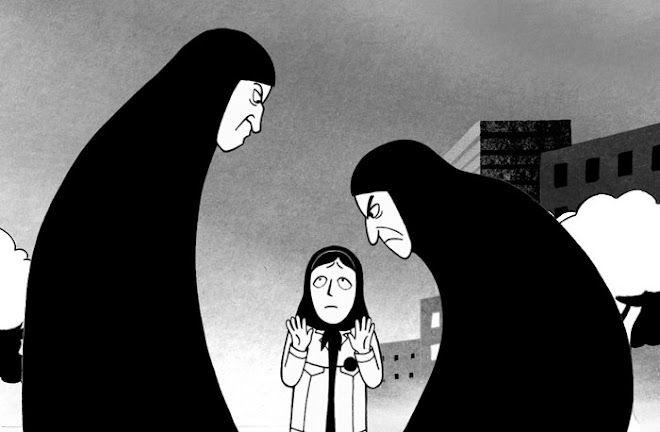
During our English classes before Spring Break, we discussed the difference between empathy and sympathy. Empathy is feeling and understanding what another person feels, and sympathy is only knowing what another person feels. This is related to Persepolis in Satrapi's simple drawing style. Without many details of the character's faces, you can more easily be sympathetic to their experiences. I am not sure if we can all be empathetic towards the events that occur, because none of us live in Iran nor have been through a war to say the least.

This can also be related to another movie I watched about the life of a boy in pre-war Germany in WWII called "The Boy in the Striped Pajamas."

The young, main character, Bruno, lives with his older sister, mother and army commander father in the country where the father comands a prison camp. Bruno eventually befriends a young Jewish boy named Shmuel who lives behind an electric fence. Being young and uneducated about his surroundings, he eventually comes to realize on his own that Shmuel is a Jew, and that the yard behind the fence is actually a camp. It was a brilliantly excecuted movie that was both distressing and moving. I recommend it to everybody. This is quite similar to Persepolis in the sense that young Bruno is living in a society where war is present. However, unlike Marjane Satrapi and her family, his parents keep him in the dark. I also believe that Marjane is mature for her age and not only sympathizes with people involved in the war in Iran, but is also empathetic (in her own way) with all of them. On page 16, Marji dresses up as revolutionary leaders and this is considered her games as a child. Bruno, on the other hand throws a ball to Shmuel over the fence. Shmuel looks solemn and Bruno asks harshly, "Do you not like playing?" Another difference is that Marjane on page 12 is shown reading "Dialectic Materalism" while Bruno is reprimanded reading "adventure books" instead of German war books. This is what makes Persepolis such an unique story, because Marjane is acting so differently than how we understand that children act. But, we must remember that this is an autobiography written by Marjane Satrapi herself, and we do not know if it is all true.

Megan's Persepolis Week 3: Lit. Feature Hunt

On page 164, Marjane is annoyed with Lucia's hair dryer. This brings up hair as a reoccuring motif once again. Hair, is something very important to first impressions and outer appearance. It can say a lot about a person: cleanliness, how much you care about looking good, how outgoing or daring you are, and sometimes intelligence. Studies have proven that brunettes make more money than blondes or redheads, and that "the study, which was compiled by the folks at Garnier Nutrisse hair color, also concluded the following. Brunettes are. . .

-More apt to be taken seriously.
-Thought to be the most intelligent, according to 76 percent of the survey takers.
-Thought to be the most genuine, said 81 percent of those surveyed.
-Preferred in long-term relationships, backing similar data by British hairstylist Andrew Collinge." (http://www.bellasugar.com/2697756)


At this chapter called Tyrol on page 164, both Marjane and Lucia have short hair, which could show they are both at certain times in their life. People sometimes place short hair together with innocence or toughness (depending how short), and long hair with beauty and elegance. However, this is something that is really only specific to each person.

To add on to the topic of length of hair, people also get haircuts or shaves when they feel the need of a change. On page 155, Marjane is in a new country, Austria, and has a new haircut. On page 184, Marjane gets "done up" by Julie and has a different hairstyle (for change) because of a party they are going to.

So to conclude, the symbol of hair has reoccured throughout Persepolis many times, so I believe it is a motif.

Megan's Persepolis Week 3: Class Act

During english class before Spring Break, we did a short writing session in class about literary perspectives. This is not the essay that is due tomorrow, however was just my thoughts at the time writing randomly in my journal. Please excuse any grammatical or mistakes that involve understanding existentialism.

According to a Persian philosopher, Mulla Sadra, "existence precedes essence." This, from what I understand, means that people have natural, scientific instincts that will overtake things that affect people such as religion and where a person was brought up. This statements makes sense, however can also be justified for the other way. Another belief is that people are a product of their place and time. This, in relation to Persepolis, makes complete sense. Marjane Satrapi, from what was written, is a rebel because her parents were rebels. However, if Mulla read Persepolis, he would think that all people are rebels inside, and that since that is true, Marjane's essence (Iran) also brought out her rebelliousness. My opinion is that people both have natural and relative meanings to themselves equally. People are not like other animals, we don't need only basic needs such as food and water to survive. We also need emotion, friendship, and love. I don't think this can be proven though, because as of what I know, there have not been scientific studies of humans living with only basic needs in a glass room or something.
In the movie, "Girl, Interrupted", the main character, Susanna, struggles with finding who and what she is, and feels she is wrongly diagnosed in the mental institute. I believe where she was brought up and her parent influenced who she became. Not because al humans are not intellectually and socially stable from the beginning. There was also another supporting character, Lisa, who frequently escaped the institute only to keep coming back for 7 years. Lisa, from the outside, could merely be labeled as a rebellious, outgoing and spontaneous person, however was deemed unfit for society. She was also labelled as promiscuious. These traits are all evident in every human being, however specific and sometimes amplified in others. There were also characters, such as a girl who set herself on fire. These, I thought, were more commonly suited for a psychological institution. Suicide, as I remember was also talked about with the study of existentialism. Albert Camus claimed that "there is only one truly serious philosophical problem, and that is suicide" in his "The Myth of Sisyphus". So, is this becasue of our place and time? Or is it because of our existence?

There is neither a right nor wrong answer but in Persepolis' case, I believe Marjane is a product of her place and time.

Tuesday, March 10, 2009

V's Week 3- Feedback

I have a couple of funny moments about Mondays class. Mr. Mcguigan was talking about religious fundamentalists when Georgia who was sitting next to me goes: YEA MOSES!!!! She then pauses and thinks for a few seconds until she asks the question: What would Moses say about Persepolis though???? At this moment Rushil who was sitting on the opposite side of me says: Let my people go!
My second moment was how Mr. Mcguigan emphasized how the comma was so "sssssssssuper."

Sunday, March 8, 2009

Meg's Persepolis Week Two-Snippets

I enjoyed the exercise of drawing a panel of one of our previous English studies in Marjane Satrapi's style. However, I found it really difficult to imagine a character in lets say, Twelfth Night, as a Marjane style character. So, I used the sterotype of the wealthy, arrogant Shah's clothing portrayed in Marjane's Persepolis with a mix of Uncle Anoosh. (He had the hair and face)

So, I ended up drawing a picture of Uncle Anoosh as the Duke in Twelfth Night. :)


As you can see, there is also my failed attempt at drawing Marjane as Viola with Marjane Satrapi's style of shadows on the face. Please ignore this.

Meg's Persepolis Week Two- Feedback and Literary Feature Hunt

On page 70-71, I enjoyed the discussion on the idea of existentialism when Marji orders God out of her life. She says she "was lost, without any bearings". On page 71, you see her floating through space, lost mainly because she believed her Uncle Anoosh shouldn't have been excecuted. So, I began searching up existentialism and came across "Transcendent Theosophy".
It was developed by Mulla Sadra, a Persian philosopher. His main concept was that "existence precedes essence", and from what I have found from my studies, I believe the meaning would be that the existence of something is more important than its essence or nature. Sadra believed that since what affects us first is what exists, and then we form the idea of its essence or nature, existence comes first. This is very different from the traditional views that the essence of something is more important than its existence.
This relates back to what Mr.McGuigan always says "Do human beings have natural instincts? Is there something in our nature that causes us to do things?"
I always thought that was just English jibber jabber, but little did I know, it was actually philosophy.

I somewhat agree with Mulla Sadra and other philosophers, that humans have natural instincts (existence). I believe that religion (essence) is not either a good nor bad thing, because there have been situations between for example; racism against certain religions versus others, or religion giving people hope during a horrific situation.


(PS. I figured out how to scan books!)

On page 127, there is a symbol being used in place of something. It is the bright light bulb on the last panel in place of an idea. This light bulb is commonly used in comic books to represent when a character is thinking, and suddenly, like a light turning on, they have a plan/idea. The light bulb is also a reference to Thomas Edison, who had a great idea and created the incandescant light bulb.
On the next few panels after this idea (pg.128), I loved (and found it quite hilarious) to see Marji's parents going to a lot of trouble to disguise a Kim Wilde poster in her father's jacket. It reminded me of my parents, especially because the mother thought of the idea, and the father excecuted it in a hilarious fashion.
I also love the transitioning between the 3 panels then the tall one panel of the father.

Wednesday, March 4, 2009

V's Week One and Two- Feedback

A very truthful quotation taken from Manny: "We do not know if the authors meaning was translated correctly because this text was originally written in French." Manny was explaining to our table group that this book was originally written in French and not in English therefore, the meaning intended for the audience to grasp might have been distorted.

I particularly liked what Inder said about how as time passes, rules and people change. He was referencing to page 44 about how the Shah had just been kicked out and the students were told to rip out all the photos of the Shah.