Marjane

Marjane
Showing posts with label Empathy. Show all posts

Tuesday, March 31, 2009

Megan's Persepolis Week 4: Snippets

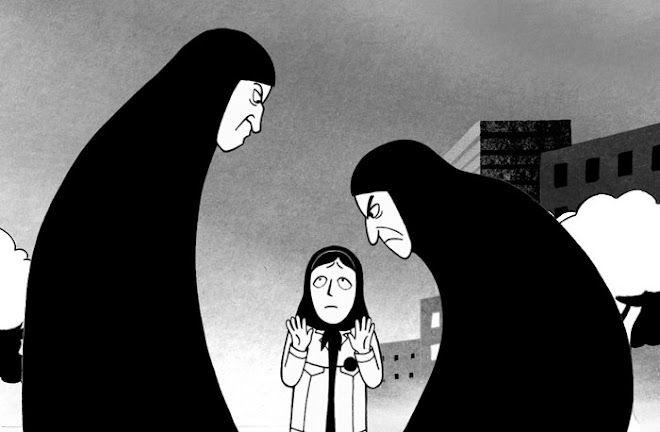
During our English classes before Spring Break, we discussed the difference between empathy and sympathy. Empathy is feeling and understanding what another person feels, and sympathy is only knowing what another person feels. This is related to Persepolis in Satrapi's simple drawing style. Without many details of the character's faces, you can more easily be sympathetic to their experiences. I am not sure if we can all be empathetic towards the events that occur, because none of us live in Iran nor have been through a war to say the least.

This can also be related to another movie I watched about the life of a boy in pre-war Germany in WWII called "The Boy in the Striped Pajamas."

The young, main character, Bruno, lives with his older sister, mother and army commander father in the country where the father comands a prison camp. Bruno eventually befriends a young Jewish boy named Shmuel who lives behind an electric fence. Being young and uneducated about his surroundings, he eventually comes to realize on his own that Shmuel is a Jew, and that the yard behind the fence is actually a camp. It was a brilliantly excecuted movie that was both distressing and moving. I recommend it to everybody. This is quite similar to Persepolis in the sense that young Bruno is living in a society where war is present. However, unlike Marjane Satrapi and her family, his parents keep him in the dark. I also believe that Marjane is mature for her age and not only sympathizes with people involved in the war in Iran, but is also empathetic (in her own way) with all of them. On page 16, Marji dresses up as revolutionary leaders and this is considered her games as a child. Bruno, on the other hand throws a ball to Shmuel over the fence. Shmuel looks solemn and Bruno asks harshly, "Do you not like playing?" Another difference is that Marjane on page 12 is shown reading "Dialectic Materalism" while Bruno is reprimanded reading "adventure books" instead of German war books. This is what makes Persepolis such an unique story, because Marjane is acting so differently than how we understand that children act. But, we must remember that this is an autobiography written by Marjane Satrapi herself, and we do not know if it is all true.

Tuesday, March 3, 2009

Megan's Persepolis Week One and Two

Week One Lit. F. Hunt and Week Two Class Act

On page 25, the last panel shows Marji gazing down at her hands which were "wrinked... like Grandpa's" after taking a bath. Marjane took this bath in order to understand what it felt like to be in a cell filled with water. This is a good example of a simile that relates back to the plot. Marjane, throughout her life, places herself in other people's shoes to understand herself and Iran's past. This idea references the discussion we had in class about the quote:
"Traditionally, the hero somehow represents his/her society and carries with her/him its hopes and fears."
Marjane represents each part of Iran throughout the graphic novel: the religious side, the rebellious side, the women/children minority and empathizes both classes.
On page 6, she wonders why her family's maid does not eat with her, and why her maid cannot love their neighbour. This, of course, is because of social classes. If this quote is correct, we can assume that Marjane is the heroine in this graphic novel.

Also interesting, is that most people would associate being young with being free, and adulthood with being conformed and imprisoned. However, it seems like the somewhat of the opposite for Marjane. She starts to feel free from the struggles of her home when she finally leaves. (This relates to the other discussion topic: "To what extent are people a product of their place and time?")When she is a child, she spends more time learning about Iran's history rather than having fun like she does when she gets older.