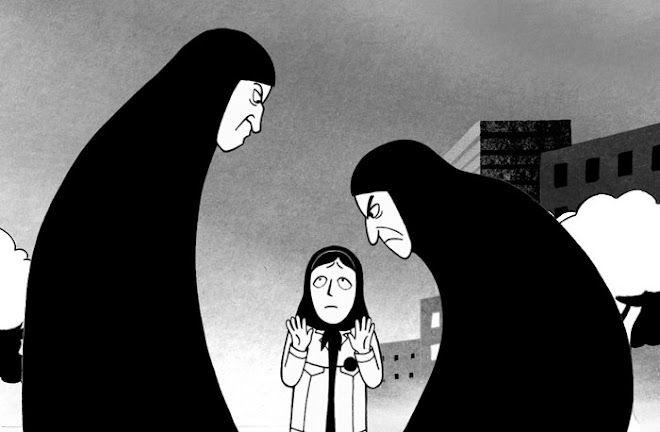
Last English day, we (thanks to our wonderful teacher Mr. McGuigan) were able to have class outside! It was beautiful, and a great backdrop to our philosophical discussions.
We discussed some questions, my favourites were:
-Does anybody actually have a personality?
-Can Marjane be considered the villain in this graphic novel?
-Is family vitally important in self-realization?
Within my group, we discussed whether Marjane could be considered a villain. This un-surprisingly lead to more questions. To answer the question, we needed to ponder:
-Are villains people that are un-likeable, or criminals?
-What is a villain?
-Can people be both a hero and a villain?
We discovered that the ever-changing definition in the dictionary was, “wicked, depraved or a criminal person.”
If this is the definition of a villain, then we are all villains at times. I don’t believe that people do villainous things throughout their lives, forever and always. It isn’t possible. However they can in moments, and this is the same with heroism. So, this idea of a hero and a villain in a story isn’t logical. In comic books, the villain is the one who is set to “conquer the human race, and destroy whoever gets in their way.” The hero, is someone who embodies the society they are presently in and protects it. And, if the story works out, the hero wins and the villain goes off to jail screaming, “I’ll get you, and your little dog too!”
This is present on page 286 where Marjane lies to the police, wears makeup (which is against the law) and unjustly send a man to jail for “saying something indecent” to Marjane, something that he didn’t do.
This was something villainous… to say the least. Marjane lied and to police to top it off! Marjane did a villainous act, but she is not a criminal. I believe people do unlawful acts, but this can’t officially prove that they are a criminal unless they go through court. Even this statement may not be true. It is a very complicated question.
In conclusion, Marjane isn’t a hero. Or a villain. Only in moments.
Marjane

Showing posts with label heroine. Show all posts
Showing posts with label heroine. Show all posts
Wednesday, April 8, 2009

Tuesday, March 3, 2009
Megan's Persepolis Week One and Two
Week One Lit. F. Hunt and Week Two Class Act
On page 25, the last panel shows Marji gazing down at her hands which were "wrinked... like Grandpa's" after taking a bath. Marjane took this bath in order to understand what it felt like to be in a cell filled with water. This is a good example of a simile that relates back to the plot. Marjane, throughout her life, places herself in other people's shoes to understand herself and Iran's past. This idea references the discussion we had in class about the quote:
"Traditionally, the hero somehow represents his/her society and carries with her/him its hopes and fears."
Marjane represents each part of Iran throughout the graphic novel: the religious side, the rebellious side, the women/children minority and empathizes both classes.
On page 6, she wonders why her family's maid does not eat with her, and why her maid cannot love their neighbour. This, of course, is because of social classes. If this quote is correct, we can assume that Marjane is the heroine in this graphic novel.
Also interesting, is that most people would associate being young with being free, and adulthood with being conformed and imprisoned. However, it seems like the somewhat of the opposite for Marjane. She starts to feel free from the struggles of her home when she finally leaves. (This relates to the other discussion topic: "To what extent are people a product of their place and time?")When she is a child, she spends more time learning about Iran's history rather than having fun like she does when she gets older.
On page 25, the last panel shows Marji gazing down at her hands which were "wrinked... like Grandpa's" after taking a bath. Marjane took this bath in order to understand what it felt like to be in a cell filled with water. This is a good example of a simile that relates back to the plot. Marjane, throughout her life, places herself in other people's shoes to understand herself and Iran's past. This idea references the discussion we had in class about the quote:
"Traditionally, the hero somehow represents his/her society and carries with her/him its hopes and fears."
Marjane represents each part of Iran throughout the graphic novel: the religious side, the rebellious side, the women/children minority and empathizes both classes.
On page 6, she wonders why her family's maid does not eat with her, and why her maid cannot love their neighbour. This, of course, is because of social classes. If this quote is correct, we can assume that Marjane is the heroine in this graphic novel.
Also interesting, is that most people would associate being young with being free, and adulthood with being conformed and imprisoned. However, it seems like the somewhat of the opposite for Marjane. She starts to feel free from the struggles of her home when she finally leaves. (This relates to the other discussion topic: "To what extent are people a product of their place and time?")When she is a child, she spends more time learning about Iran's history rather than having fun like she does when she gets older.
Subscribe to:
Posts (Atom)